21.8.07

Firejuggling

A few shots from the Rototom Sunsplash...

firejuggling

firejuggling

firejuggling

Labels: ,

16.7.07

Sunsplash Finale

The last days at Sunsplash were pretty mixed. A couple of acts really caught my imagination, namely Ziggy Marley and Groundation, but there was a also a disappointing return to the artificial stylings I wrote about on the first few days.

Having been recommended to check out Groundation some time ago, I have a few of their records, but the band is equally good if not better to see live. In the post-show press conference, keyboardist Marcus Urani talked about how the group started off playing jazz together before introducing elements of reggae and gradually arriving at the progressive sound they have today. Indeed, there was a strong emphasis on individual improvisation to complement the strong roots reggae foundations of the music. The horn section of trumpet and trombone were treated to frequent solos and it was fitting that the first bass solo I'd heard at the whole festival came on the last day. All were of a high standard and the crowd also felt the impact of the lyrics, which consciously tackle a number of prominent issues. Definitely one of the highlights of the festival for me.

I'd heard mixed things about Ziggy Marley and wasn't really sure what to expect, since I don't own any of his albums. There was some talk of the cheesy catch-line "love is my religion" as one of his major slogans, but he didn't really go on about that during his set. Instead, the extensive band gave a tight display of mostly roots-style reggae, combining original songs with new arrangements of a few Bob Marley numbers. Ziggy definitely has a hauntingly similar voice to his great father and there was no messing around with live "rewinding" or anything like that. A couple of tunes near the end did get a little commercial and tiresome, but on the whole I really liked his music.

Some of the other acts of the final two days included Tanya Stephens, Famara, Toure Kunda and Shaggy. The iconic pop-dancehall singer was making a highly anticipated appearence, which the festival organisers didn't stop emphasising was his only in Europe this year. I don't want to think about how much they paid him, but I won't go on with criticism because I think there's been enough of that recently. Out of the other names on that list, I enjoyed the African reggae sounds of Toure Kunda and his band from Senegal. Maybe it was a bit of a token gesture that he was the only real African artist playing at the festival, but the music was chilled out and relaxing - perfect for winding down on the penultimate day of this long festival.

Of course the programme was always going to be a compromise between the more and less commercial elements of reggae music, and I'm not sure if the formula was balanced in the right way. DJ Neil Perch of Zion Train summed it up during his session at the Reggae University by saying most record companies function like an "audio McDonald's" - they produce what is easiest to sell. That's just the industry for you; I think it's the same in every genre.

And I haven't yet talked about any other activities than the music: the festival consisted of a lot more than only the artists performing on its main stage. The aforementioned Reggae University ran daily sessions in the Dancehall tent on a variety of topics, from history of the music to discussions looking at specific sub-genres such as dub. The eminent biographer of Lee "Scratch" Perry, David Katz, was involved in many of these, as well as a selection of other authoritative guest speakers. The primary setback was that these workshops often ran at a very slow pace due to the need for translation into Italian or English of much of what was being said by different people, but the content was usually of an interesting nature. It was a nice idea to involve this kind of educational programme in the festival, as the history and origins of reggae music are incredibly convoluted and diverse.

There were also other performance areas such as the "original showcase" and a couple of smaller tents, which gave upcoming bands the chance to get some new fans. On the first day there was an international Reggae Contest in the Dancehall tent, the winners of which are now embarking on a lucrative tour of several European festivals. I don't really think music should be about competition, but this idea represents a great opportunity for new and developing bands to gain a greater following. Perhaps unsurprisingly it was an Italian group - Franziska - which emerged victorious; I didn't watch all the contenders, but this genre-mixing band could be one to look out for.

Finally, many attendees of the festival had the chance to develop their own skills during a series of classes in such things as African and Brazilian percussion and various styles of dance. The djembe workshops were particularly popular and it was great to see people from all different backgrounds brought together by the desire to learn.

The general atmosphere of this festival was perhaps the best thing. For the whole nine days everything was so relaxed and laid back, as one would expect from such a combination of the Italian mentality and Jamaican soundtrack. A match made in heaven? The Sunsplash has definitely been a great festival and maybe I will even return next year!

Labels: , , , , ,

13.7.07

Two in One

Didn't have time to write yesterday, so I'll go through a few highlights of the past couple of days...

The Tokyo Ska Paradise Orchestra definitely gets my vote for most entertaining act so far at this festival. Band members run around the stage with some outrageous dance moves - the horn players having clip-on mics allows them to do this - and the music was skankingly awesome. The group has been touring for years and years, which is evident from how tight their sound is and the precise accuracy of the music. Individually they are clearly all talented improvisors and their dress code of white gangster suits pretty much completed the audience's captivation. The CD I have is good, but this band needs to be seen live to enjoy the full experience. Catch them if you can!

The disappointment of that night was the fact that Israel Vibration didn't arrive in time and couldn't perform until the next day. I think they finally made it here at something like 6am, so it's impressive they came out to play at 1pm after that. In any case, the legendary roots band lived up to expectations. Both lead singers suffer from polio, contracted during the Jamaican epidemic, and their story of a rise to fame is amazing. Stumbling around the stage on crutches, they may have looked weak in appearance but the strength of their music more than compensated.

Anthony B played an extended set on Wednesday night, which went on for a bit too long in my opinion; nevertheless, I thought he did a good job and went down really well with the crowd. I think this is his second or third time at Sunsplash, so the people here know what they're getting. His press conference after the show was also fascinating: someone asked a question about what reggae artists really think about Africa and if they ever go there, which is a potent issue considering the nature of Rastafarian religious beliefs. Anthony B then talked about how difficult it is for Jamaican people to get visas for any kind of extended stay in many African countries, speaking at some length and giving various examples from personal experience. A lot of people from the island state want to go back "home" to Africa, but are unable to do so because of these political restrictions; Bob Marley's often-repeated call for Africa to unite is clearly still more dream than reality.

Popular dancehall artists Fantan Mojah and Beenie Man have also performed here on the last couple of evenings, but I didn't really enjoy them as much as Anthony B or Gentleman. There was one funny moment when Mojah brought a random girl out of the audience to dance with on stage, but she was clearly too spaced out to know what was going on and didn't respond at all. Beenie Man was going down well with the people and he has a great presence, but the "King of Dancehall" only had a couple of tunes which I really liked.

Last night I discovered an original trio playing one of the smaller cafe tents at the festival. Triad Vibration are comprised of drums, bass and didjeridoo and their largely rhythmic style had people dancing like crazy. As a sax player in a funk band, it was great when the bass player brought out a bit of the slap technique - I had been dying to hear something like that for quite a while. I think they're hanging around to play a few more days too, so I will definitely be going back to that tent.

Tonight there's an interesting lineup including bands from Switzerland and Senegal, with Ziggy Marley finishing things off. He was a fairly late addition to the festival programme and I don't know much of his music, so I'm looking forward to see what kind of influences he draws from the style of his father and brothers.

Labels: , , , , ,

11.7.07

Roots Rock Reggae?

Five more bands to look forward to this evening, starting in probably just over an hour with the Tokyo Ska Paradise Orchestra. This ten-piece ensemble has apparently played at Sunsplash before and went down very well; I've got one of their albums, but I definitely didn't expect the band to show up here, coming all the way from Japan. In any case, it will be nice to have a change from the reggae and dancehall vibes of the last few days.

Second on the main stage are the legendary roots group Israel Vibration. The band emerged in 70s Jamaica coming out of serious poverty to record a number of popular songs. Since then an extensive discography has amassed, but the original vocal trio has been through various splits and rifts and is now a duo. A friend of mine in Romania originally recommended Israel Vibration to me and I have enjoyed their music ever since, so to see them live today is pretty exciting.

Perfect, Fantan Mojah and Anthony B complete the lineup. I recently acquired Anthony B's latest record, Higher Meditiation, and there are some good tunes on there. His style is less roots and more dancehall again. As for the other two, I don't really know very much, but I have heard some positive things around here about Fantan Mojah.

As for last night, the major headline name was Gentleman and his Far East Band, which was more than impressive. It was definitely the best backing group I've seen at the festival so far, with a full horn section and three singers as well as the standard guitar, bass, keys and drums. So much of the time dancehall rhythms can become easily monotonous, with the same patterns coming out song after song, but this was not the case with Gentleman and that made the set a lot more interesting for me. He also player a few tracks from the album I have, entitled Journey to Jah.

Katchafire weren't quite as original as they had described themselves, but it was still a good show and their final song was a great cover of Bob Marley's "Iron Lion Zion", one of my favorites of his tunes. Prince Theo and Horace Andy were playing roots reggae and I especially enjoyed the latter, who came on to play the final set at around midnight. Andy has an amazing voice - some might even think it to be female first listening - and his songs were all about issues which were a lot more apt and suitable than what most of the modern reggae singers talk about. There's another recommendation for you.

Labels: , , , , ,

10.7.07

Torrential Downpour

So far I haven't really had the time to write about anything other than the music here at Sunsplash. I'm planning to talk about things like the atmosphere of the festival and other activities which have been going on, but today it's going to be the weather...

Up until yesterday afternoon everything had been perfect, with the festival living up to its name and the campers drenched in sun. It must have been nearly 30 degrees at times - definitely what I had been needing after mixed fortunes in Brussels and Prague over the last couple of weeks. I knew something would eventually have to give... and yesterday it did, with heavy rain and then a tropical storm like no other I have ever seen. Rain pounded down for what seemed like hours and when I returned to my tent after the music I felt like it was going to be swept away by the gales. I think I managed to get to sleep after a while, but then at around 7am it took off again. Everything was completely soaked this morning; I'm surprised no water found its way inside.

Having said that, things seemed to have brightened up today and the park seems to be slowly drying off. Hopefully the process will be completed by the time the music starts later.

Last night four bands headlined the festival. Tony Rebel, Ras Charmer and Warrior King were all pretty similar in my opinion, mostly in the dancehall style. The opening group, however, provided a refreshingly creative outlook on reggae. Coming from Switzerland, the Moonraisers started off playing to under 20 people straight after the first shower, but more quickly joined in as the set got underway. Their sound wasn't roots reggae in the strictest sense: they incorporated various aspects of world music as well, including one tune which featured only didjeridoo and percussion. To finish off, the band played cover versions of Hotel California (which apparently they are quite famous for) and a Bob Marley classic.

The lineup this evening consists of Prince Theo, Katchafire, Gentleman and Horace Andy. I am familiar with only the third of these names, but according to my research the others are playing largely in a roots style and Katchafire, from New Zealand, blend elements of traditional tribal music into their songs. Horace Andy is a well-known vocalist who has worked with such artists as Massive Attack, so it will be good to see the material he produces under his own name. Gentleman, from Germany, is a predominantly dancehall artist and he is the one I knew already, since I have one of his albums. Hopefully the material tonight will be of a similar quality.

Labels: , , , , ,

9.7.07

Technical Rastafari

Last night was definitely the best one for music so far. Four hugely differing acts took to the main stage and three of them were really good.

Starting at 6pm were the Brazilian group Olodum, whose style I can only describe as a unique form of world fusion. With a full samba rhythm section of nine individual drummers, the beats coming out were utterly danceable. The use of reggae-style vocals and chord patterns, as well as Latin horn section arrangements, created an exotic cocktail of musical ingredients from across the globe. I don't have much time to write more now, but I'm definitely going to be on the lookout for this band and I recommend anyone with an open ear to check them out.

Second on the main stage was General Degree, an emerging dancehall artist from Jamaica. A couple of his tunes managed to get the crowd going, but in my opinion his style was closer to commercial hip-hop than any kind of reggae music. This was particularly notable from his lyrics and the apparent love of gripping his own crotch during songs, with the microphone in the other hand. Maybe this guy needs to get a degree in musical enlightenment. And one other thing: why do so many groups adopt the habit of making false starts to tunes, before doing a rewind and starting again? Degree did this at least five times and so have many other bands over the last few days. I can see what they're trying to do in building up suspense, but when people start dancing and then have to stop after a few seconds it can really shatter the mood.

The final two acts - Zion Train and the Easy Star All Stars - are definitely among my favourite performances so far. I finally managed to find an ounce of satisfaction at my nationality following the performance of Zion Train, as this dub/dance outfit hails from the UK. Their set took quite a long time to get going, largely due to technical difficulties at the very beginning, but the combination of alternating vocalists with a DJ laying the foundations and a live two-piece horn section was perfectly formulated. Typically their songs began with a couple of layers in dub, building up the atmosphere before heavier beats set in. I'm definitely going to try and get hold of some of their material back at home.

The Easy Star All Stars, coming from New York City, famously play reggae cover versions of well-known albums. To date they have released Dub Side of the Moon and Radiodread - covers of Pink Floyd and Radiohead respectively. Last night they showcased material from both discs, which I have heard in snippets before, and had the people dancing for the whole show. For me it was great to see a little more space given to instrumental solos than is normal - the guitar, keyboard, trombone and sax players all had opportunities to break out. My expectations for this act had been high and they were definitely fulfilled.

Tonight sees four more groups: Moonraisers, Ras Charmer, Warrior King and Tony Rebel. I haven't had much time to check out information, but Moonraisers look like an interesting band and the last two names are pretty big in the world of reggae. So hopefully it's going to be another good one.

Labels: , , , , ,

8.7.07

Sunsplash Day 2

After the first day's disappointing musical lineup, I was thinking the only way could be forward. This proved to be true and my predictions from yesterday about the artists turned out to be correct. Junior Kelly's style was largely based in dancehall rhythms, but sadly it was of a more commercial nature than I would have liked. However, it was still worth checking out and he also gave a public press conference after the show - I think this is a really nice idea because it gives the fans a chance to get a greater insight into the personality of performers.

The ludicrously-named Bitty McLean was next on the main stage and I didn't stay for long. It was pretty much the same kind of music that I had been dreading: the unoriginal blend of pop-style vocals and the occasional reggae background. I also thought it was pretty funny when he piped up in a strong Birmingham accent between tunes. As well as the songs, there was another disappointment for real reggae fans regarding this act. The original festival programme had listed that McLean would be appearing with Sly and Robbie, the legendary drum/bass production duo, who are credited with changing the face of reggae several times since the 1970s. However, it emerged that the pair cancelled their performance, stating the reason of a broken leg; this will surely disappoint a lot of fans and one person told me it's not the first time a withdrawal had happened for this same reason. Suspicious.

Africa Unite were the last band to play. They are the oldest Italian reggae group, having been active for 25 years or more, and the performance was suitably distinguished. Although most of the songs were in Italian, I still really enjoyed the rhythms and musical moods they created. Elements of dub, roots reggae and sometimes rock were present in the mix and there was also creative usage of electronics involved. They played until around 2.30am after an encore and the inclusion of several guest vocalists, and it was definitely the most enjoyable act I've seen so far.

Tonight looks to be another varied one on the main stage, featuring dancehall, dub, roots, samba and more. I'm looking forward to the Brazilian group Olodum, whose description sounds like something truly unique. More later.

Labels: , , , , ,

7.7.07

Live at Rototom Sunsplash

A green haze has descended on the beautiful surroundings of Rivellino Park near the village of Osoppo, north Italy. Music lovers from this country and around Europe have arrived en masse for one of the continent's biggest reggae festivals: Rototom Sunsplash. The skies are clear and the sun is shining; the volume of smoke generated by this event must surely be worrying aircraft pilots flying overhead.

But where's the Reggae?


Last night the main stage was pretty disappointing. I can only say I enjoyed one of the four artists on display; the others were playing such a distorted, pop-centric version of reggae that I found it pretty much impossible.

The first three acts - Zoe and her "Okada Supersound" band, Maxi Priest and another singer whose name escapes me, were not really playing reggae in my opinion. The backing bands were well-drilled and immaculate, but the songs were certainly not traditional of this genre. Instead, they went on and on about love and the usual kind of popular kitsch; the only thing which distinguished them from bog-standard manufactured pop tunes was the presence of real musicians and the occasional insertion of off-beat reggae chord structures.

Maxi Priest is apparently the greatest-selling reggae artist currently alive. I don't pretend to be an expert in this style of music, but surely Bob Marley - whose giant image overlooks the performance area - would be turning in his grave from this fact. His voice is identical to any of the pop singers you hear on the mainstream radio stations and the same can be said of Zoe. They share the same richly cliched approach of using false American accents, which in a way probably explains their apparent popularity with the standard audience. However, it was pretty satisfying when, on receiving the question "do you want some more Maxi Priest?" from the announcer, the crowd's response was less than enthusiastic and he did not return.

Now, that's probably enough moaning about the bad music. I had been looking forward to the final act even more after the opening disappointments, and Sizzla definitely lived up to expectation. His performance was full of energy, vibrance and charisma which brought great relief to the hardcore fans. After less than five actual reggae songs from all the combined preceding artists, it was good to have some real music at last. Frequent calls from the singer for people to raise their lighters (and other assorted pyrotechnic devices) kept everyone involved and he patrolled the stage commandingly.

Hopefully that will be a sign of things to come, because I've had enough soft pop-reggae to last me for the rest of this nine-day festival. Of the artists on show tonight, I'm looking forward to Junior Kelly's similar dancehall tunes and Africa Unite, which is one of Italy's oldest reggae bands. Bitty McLean from the UK looks to be more of the same regurgitated pop nonsense, so maybe I will give that a miss.

Labels: , , , , ,

30.8.06

Going East in Berlin

Ampelmann

Brazilian Welcome

Don't Cross Now

Roadside Reflections

Really?

Neglect

Labels: ,

26.8.06

Englischer Garten, Munich

Abandoned

Stream

Illustrated Landscape

Perspectives

Relief

Sneaky Reflection

Window to the skyline

Labels: ,

24.8.06

Giant Orange Megaphone

The Giant Orange Megaphone

Mesmerised

Orange Eternity

Labels: ,

23.8.06

München

Rathaus München

Fußgängerzone

Red Munich Strikes Back

Looking up

Liebfrauenstrasse

Marienplatz

Labels: ,

22.8.06

Berlin Wall artwork

Curriculum Vitae

Colourful

Mysterious Names

Handprints

Broken Baby

Confusing Faces

Through a gap

Cloudy sky

Totaldemokratie

The famous image

Funny Complexion

Labels: ,

19.8.06

The Breakdancers of Berlin

How do they do this??

Breakdance

Balancing act

OK, so this last guy isn't really breakdancing - but it's still pretty impressive.

Labels: ,

9.2.06

One of Europe's Forgotten Capitals

Recently had this article about Vilnius, the capital of Lithuania, published on travel website Boots 'n All:

It was little past six in the morning as I struggled down the dark, deserted, seemingly desolate street. Every bone, muscle, ligament, cartilage, tendon, capillary, pore, skin cell, nucleus and microscopic bacteria particle was screaming against the weight of a massive backpack, filled to bursting point with essential travel items such as ipod and portable mini speakers, which I’d spent most of the previous night cramming in at the last minute.

It’s a tricky task to reduce your worldly possessions into fitting a space smaller than most car hatchback compartments. Finally, exhausted and sweating underneath heavy winter garments, I crashed down onto the perforated metal bench at Chiswick train station and hastily relieved myself of the excessive weight, swiftly sweeping away several empty cigarette packets and other assorted detritus. My shoulders were burning and felt like they wanted to give in, despite the fact walking this distance had taken barely ten minutes. A vigorous saleswoman had talked me into purchasing some kind of deluxe carrying system the previous day, which she claimed was designed to minimise physical strains and optimise the lugging experience. It certainly didn’t feel like that right now and the prospect of heaving this cargo round half of Europe during one of the coldest predicted winters on record wasn’t exactly appetising.

The train at least arrived less than ten minutes later and I got off at Clapham Junction, hauling the monster along before boarding another service to Gatwick Airport. I took a moment to appreciate that this could be the last remotely reliable public transport system I set foot on for the rest of 2005.

Once I'd completed the formalities of checking in and handing over the booty for ruthless battering in the cargo hold, it was time to explore Gatwick's departure lounge. Indeed, I had considerably more time to do this than anticipated, since my flight to Vilnius got delayed by a good half hour. Sometimes I think they do it deliberately, to try and force frustrated passengers away from starting blankly at the announcement screens and into the shops around them (it's no coincidence to find a dearth of seating around the TV update points), with the vague hope we might erupt into a panic attack, thinking we've forgotten something, and rush to hastily replace it with an overpriced substitute – before arriving at the destination and realising the original had been there all along. Thankfully it didn't happen to me on this occasion, I just slumped down into the first available seat, situated at a remarkably bad angle for viewing the monitor, and thought about nothing in particular until the gate number finally came up.

My travelling companions were a motley collection of Lithuanians, Brits and the kind of miscellaneous Euro-trash which can be frequently found on such ventures, along with the usual array of Doctor Who lookalikes and confused bearded people who don't seem to know where they're flying. One of these anonymous random entities, a tall woman with a terrible dyed hairdo, somehow managed to sneak through the security gate without anyone noticing and trigger a wailing alarm on the door leading to our aircraft's boarding jetty. Once the shrill, repetitive squealing had begun it was a good few minutes before a BA staff member, immaculately attired in double-breasted suit jacket with mismatched beige trousers, had the initiative to actually go and find out what was wrong, arriving at the scene to find the mysterious lady still grappling with the door in her bid for freedom and ignoring the siren which everyone else was being driven mad by. She turned around and ran away down the corridor as she saw him approach and proceed to fiddle with the mechanism with no apparent effect, swiping cards and punching codes to his heart's content.

When, after around five minutes of this, he realised nothing was going to change, two colleagues were called in as backup and the process repeated to no avail. It was a faintly amusing spectacle at first, especially in the context of a dull airport waiting area on a grey Monday morning, but once the alarm bell had been blaring out for ten minutes the humorous effects quickly disappeared. Eventually, after more extended periods of fooling around with the control panels and doors, the stalwart staff members appeared to give up on rectifying the problem and we were left to enjoy the noise. I could see British passengers quietly tutting to each other, in the well-practiced and time-perfected national manner, trying in vain to ignore what was going on by shielding themselves with complementary copies of The Daily Telegraph.

After all that excitement, the flight itself was comparatively boring: I slept for most of it, basking in the luxury of having three seats in row 19 all to myself and making the most of this chance to catch up on lost hours. However, my fondest visions of being able to create cakes with my hands by magic vanished from thought as I was rudely awoken by a stewardess and half-consciously took in a babbled patronising explanation that we were about to land and I needed to put my seatbelt on. Out of the window, the Lithuanian countryside was looking very natural and small buildings were dotted about, making the whole thing look like a moving model village. This miniature vista of civilisation grew steadily larger and we had a traditional bumpy landing. Air journeys just aren't complete without one of those, which give the always moan-happy British another thing to viciously tut at, threatening mutiny or cockpit invasion because little baby Romeo was abruptly roused from peaceful slumber.

Going through the motions of entering Lithuania was pretty routine as well, with no major sticking points even for the seasoned British complainer. I was one of the last to come out, mostly because the surly passport officer was quibbling and blundering around with a minor issue regarding someone else's documents, but the upside was that my Tyrannosaurus Rex of a backpack was floating along on the conveyer belt waiting to be collected when I finally got through, mercilessly poised to once again greet my back muscles with customary anguish.

Could any destination be worth this hellish horror story of a travelling experience? In my opinion, yes, because it wasn't actually all that bad and Vilnius is really very interesting. Wandering around the city, I found it similar to Tallinn in that there is a clearly visible contrast between old and new. Architecture dating back centuries is in close proximity to towering plasma TV screens (well, actually just one, on top of the opera house) and garish riverside lighting features. However, one big difference I noticed was in the general standard of maintenance. Rundown apartment buildings with glassless windows, peeling paintwork and walls of cracking cement lie within yards of imposing government ministry offices, one of which had a very new-looking large pointless sculpture directly in front and rows of shiny cars parked neatly around it.
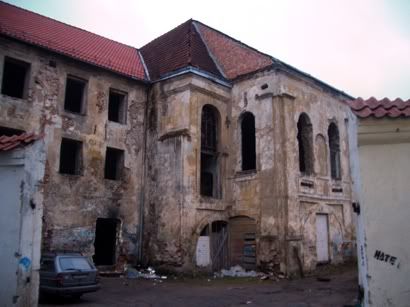
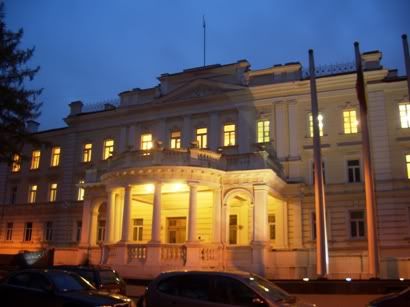
A dilapidated apartment building...

Government ministry office
...and a fancy government ministry office just down the road

Nearly all the other vehicles I saw were dusty and dirty, one with a rear windscreen mended by excessive amounts of heavy-duty brown sticky tape and bumpers sagging to the ground. A couple of others were giving off alarm sirens for no apparent reason (as if I hadn't had enough of that already), including a battered jeep containing a perplexed and bewildered canine occupant. Stray cats skulked around the dilapidated structures and a couple of what might have once looked like authentically-designed churches were surrounded by scaffolding.
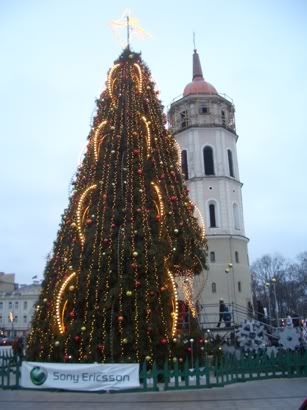
Vilnius town square

By contrast, popular tourist spots – such as one tall bell-tower resembling a lighthouse – glow monotonously as dusk settles and a tackily illuminated Christmas tree in the town square threatens to induce epileptic fits from oblivious onlookers. But surely something needs to be done to preserve the everyday heritage of this historic city? Venture even a small distance away from the main streets and you're greeted by a chorus of decay and despair from sites which should be well looked-after.

Vilnius doesn't seem as dependent on tourism as Tallinn is, probably because it doesn't get as much. There are far fewer souvenir shops – only one was listed on the hotel's information computer, believe it or not – and there seems to be more of a self-sustainable local economy based on small businesses. Take away the tourism and there could well be problems, but at least there isn't total reliance on that particular form of income. Lithuanians work to serve each other, not only foreign visitors, and that's important in small European states looking towards progress and development.

One of the forms of public transport in Vilnius is what I would describe as a strange hybrid of bus and tram. Known by locals as "trolleybuses", these vehicles are identical to buses but also similar to trams in that they have overhanging cables. So it's a bus with the extra cables or a tram without the tracks. I've never seen anything like it, but apparently they're better for the environment than normal buses. On my final night I had to catch one in order to reach a large supermarket and unfortunately was fined the princely sum of 15 litas (£3) on the return journey for not having a ticket (had got away with it the first time). I tried to pretend I was Spanish and didn't understand the clearly visible notice of "validate your ticket immediately on boarding the vehicle" in Lithuanian, Russian, French, German and English, but the inspector wasn't having it. Annoyingly it happened just as I was about to get off, but I know the penalties would have been 200 times worse in London.

Another time when I did actually use public transport, rather than stare at it, the experience was a crazy one. On Saturday evening I decided to visit the European Park with two friends, Artem (from Ukraine) and Jan (a Slovak). The park is situated in a forest and contains sculptures and other forms of modern art which were, according to Jan, illuminated at night. He had a timetable from the internet of when the bus service operated and a map of where to catch one from.

Walking from the hotel to our designated destination gave me a new sense of the contrasting nature of Vilnius. After heading away from the city centre for about ten minutes, it was surprising to discover that civilisation seemed to evaporate – the modern homes, offices and other buildings were gradually replaced by wooden shacks and log cabins. Roads were empty of cars and pedestrians alike. It was as if we had somehow gone off course or travelled back in time and ended up in a rural village.

This experience got even stranger when, after passing through this undeveloped area just outside the city centre, it became urbanised once again. The streets were more populated and structures of a newer design. There were many bus stops and we became somewhat confused as to which was needed. Eventually we worked it out though and the bus, number 92, arrived without delay at roughly 4.30. According to the timetable, we would be able to catch one back at 6 p.m.

It was actually more of a mini-bus, with about 20 occupants at most. The fare was two litas, around 40 pence, and we sat at the back. Other passengers included drunks, chattering ladies eating chocolate and suspicious characters in large coats, who gave us strange glances because we were speaking English. Lithuanian music was playing quietly in the background and not much heating was provided – at first it was as cold inside as it had been outside.

We were soon to abruptly find out our plans were not as simple as we first thought. The important lesson here is: if you can't have a native, always have a Russian speaker with you when travelling in Lithuania. We needed clarification on when to get off and at what time the bus returning to Vilnius would arrive; within a few minutes Artem had found out the one we were on would be turning around after the last stop and was the final service of the day. It did not operate so often on weekends and the timetable we had was obviously outdated. So we were faced with the prospect of a wasted evening, in which all we would have done was sit on a freezing bus.

However, after more enquiries an alternative route was discovered. There was another bus which would leave from a stop within walking distance of the park at a later time, so the plan was back in motion. We got off at what seemed to be a location in the middle of the forest and found the park's entrance.

We then discovered it to be closed. The ranger was about to drive away as we arrived, explaining it closes at dusk and there is no nighttime illumination of the sculptures. As we heard this information, the bus drove off and it appeared we were marooned in the middle of the countryside, surrounded by snow and trees, without a clue in the world about how to get back.

It was our lucky night though, as a car approached out of nowhere and Artem negotiated a free ride back to the bus stop, so we could catch the same one we'd arrived on after it turned back to return in the direction of Vilnius. To walk here would have probably taken nearly an hour, so we'd have missed it, and the weather was also incredibly cold. Being in the middle of dense, snowy woodland in the winter darkness wouldn't exactly have helped either; things could well have ended very differently.

So, the moral of this story is to always have at least a Russian speaker with you when in Lithuania, especially if a Lithuanian isn't possible. Although most of the young people can speak decent English, older generations did not learn it – so Russian is the only option unless you happen to speak the native tongue, which is apparently the oldest language in Europe. And who would have thought Lithuanians were the ones who invented strings of cheese?

Link to story: click here.

Labels: ,

8.1.06

End of the road

Arriving here from Belgrade, New Year’s Day was a tired affair. We slept for most of it.

On the way from the central station to my friend Adam’s apartment, one of the first things I noticed was the amount of homeless people sleeping in underpasses. At least they are sheltered from the worst weather elements here, but it’s still incredibly cold and the problem stares everyone in the face – why hasn’t something been done?

Speaking of the weather, it was terrible. Monotonous raindrops pattered on the apartment windows for two days, meaning I didn’t really want to get up and go out at all. It was like being back in England. Perhaps tiredness from so much travelling was starting to accumulate – it had been around three days with hardly any sleep, so I’m sure that was playing a part too.

When the rain finally seemed to ease up, I went for a walk around the nearby area in search of food. It took a very long time to find the local supermarket, a modest Spar branch; it’s true I didn’t know where to look, but you would have thought there to be quite a few possibilities on the main streets. As I came out with a bag full of supplies, purchased for a ridiculously low price, the heavens opened once again and I hurried back for some dinner.

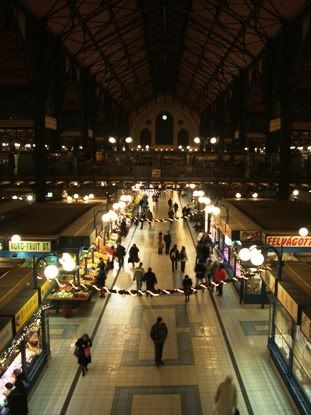
The market hall from its second floor

The next day it was a bit nicer outside, so Adam gave me a guided tour round some of Budapest’s main places. We started off at the cavernous market hall, which I should have visited the previous evening – this seemed to be the centre of local shopping activities. Even quite late in the day it was still pretty busy (peak time is apparently early mornings), with stallholders selling a variety of products including food, drink, clothes and tacky souvenirs. This must be why it was so hard to find a commercial supermarket; everyone comes here instead.

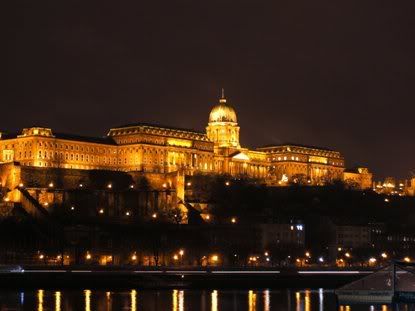
The Castle of Buda

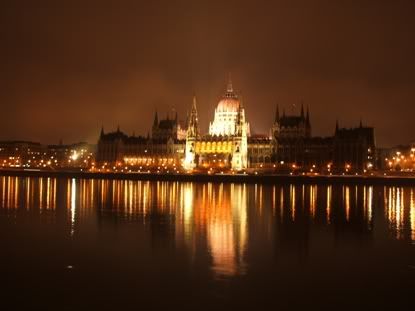
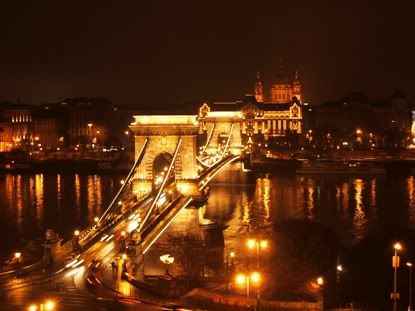
After this we headed to the Danube riverside, where some of the city’s illuminated attractions can be seen. Budapest life in times gone by was heavily dependent on the river and it also has some spectacular bridges. The first thing which caught my eye was a large castle, lit dramatically on a hill. But one of the finest old buildings, the Hungarian Parliament, was hardly visible at all; only the middle dome section had proper lighting and this was a great disappointment. I could see similarities in design to the British one, so it would have looked great.

The Hungarian Parliament

One of Budapest's grand bridges from a high viewpoint

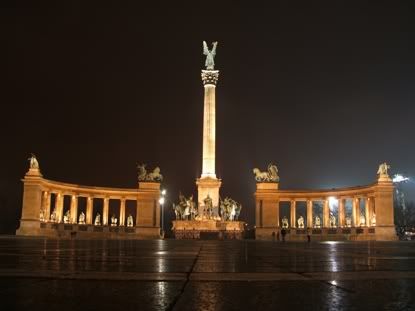
Soon after we arrived at another famous landmark: Heroes’ Square, the largest in Budapest. It was empty apart from a few people wandering around, a couple of which asked us about restaurants in the area, and one man with a camera and large tripod. The main column has a statue of the Archangel Gabriel at its summit and the others surrounding it are eminent figures from Hungarian history. The whole thing looked great at night too.

Heroes' Square

Walking through the chilly streets, we had to be very careful watching out for dogs' natural waste. Budapest has an unusually high ratio of pets to population: something like 600,000 animals for under two million people. And the owners aren’t as well-trained as they are at home either, which means you’ve got to watch out – especially when it’s dark.

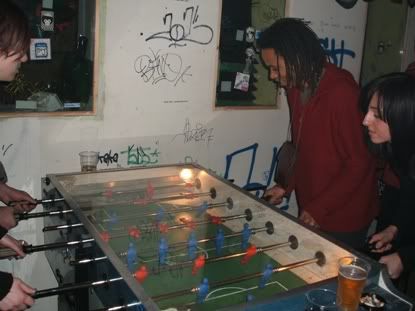
We had dinner and then moved on to a very interesting nightspot, the ‘Clutch’. It’s a spacious bar/concert venue which used to be a carwash. On one side was the bar itself and there were lots of little tables with chairs scattered around, nearly all occupied even on a Tuesday evening. The vibrant buzz of people speaking created a nice social atmosphere. Foosball tables were everywhere with queues to play – it’s the national Hungarian activity in places like this and everyone’s really good.

Foosball crazy

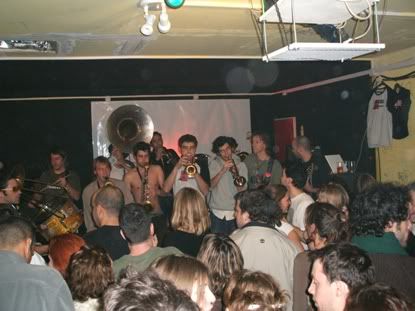
There was a gig taking place that evening, in a smaller room adjacent to the main area. It was a French band named ‘Les Touffes Kretins’, which featured a couple of percussionists, many brass instruments including a huge sousaphone, one guitarist and someone on the banjo. They played a crazy mixture of reggae, ska, jazz, hiphop (band members took it in turns to MC into megaphones) and just about every other musical style there is. What an amazing group, they really got everyone involved and each musician brought their own creativity in with soloing.

Les Touffes Kretins in full swing

Something negative I discovered during this trip had to do with the English people and our language. Adam is currently studying for a teaching certificate and had lots of work to do for tests when I was staying. So one evening he asked me to help out with revision. We then discovered that I didn’t know anything about the stuff he was supposed to learn, which included loads of grammatical terms I’d never even heard of like ‘morpheme’.

What’s going on? I was never taught anything beyond the very basic principles of English grammar; it really annoys me not to be able to answer advanced questions. It’s not like I had a bad education or don’t know how to speak the language – it’s just that I don’t understand why things are the way they come out, for example in sentence structures. I think this also links to the well-known fact that the British are terrible at learning other languages; I wonder what percentage of this country can honestly say they could get by with another tongue. But if we don’t even know how to speak our own language, this isn’t really surprising. I think my German would definitely be better now if I’d learnt proper English grammar as a child. The Hungarians do this with their language, so why can’t we? It’s clearly a big hidden flaw in the education system and something has to be done.

Hungarian is one of the languages in the small group of random ones, which are unrelated to any in surrounding countries. It is joined by Finnish and Estonian in this elite selection, but they are only similar in terms of grammar as far as I know. The only two words I managed to pick up were yes and no – ‘igen’ and ‘nem’ – as well as a couple of curses that some would argue are equally useful.

Another thing I discovered was the term “conference tourism”. I’d never heard it before, but I can think of no better words to describe what I’ve been doing on and off for the past six months.

I was due to leave Budapest on January 6, taking an EasyJet flight to Gatwick. When that day came I could feel a strange sensation inside. It was like the last few weeks had just been a blur; I’d travelled through 15 countries and this was the end of it all. Disembarking in Vilnius on November 28 seemed both like it had happened yesterday and, at the same time, felt a bit like a distant memory.

The same applies to the last six months of my life, since I finished secondary school with my last exam on June 30. It’s been nearly constant travel since then. Countless awesome people, places and experiences later we’re in 2006 – a new year which will bring new beginnings for me. But to be at home now, knowing there won’t be any more expeditions during the foreseeable future, is very weird. I’m not sure I like it. I’m not sure I even like being at home anymore.

Labels: ,

5.1.06

Confectionary conflict in Vienna

The only other time I visited this country was on a day trip to Salzburg, famously the birthplace of Mozart (he was everywhere). Austria’s capital is well-known as being one of the historical centres of modern Europe; it was easy to see why.

Coming off an early train from Bratislava, excited at the possibility to explore the final destination of my European adventure, my spirits became somewhat deflated when I walked outside to be engulfed by an icy chill. I may have been lucky with the weather in places like Venice, Rome and Zagreb, but that luck definitely started running out as my trip entered its latter stages.

Immediately noticeable as I walked from Vienna Südbahnhof towards the city centre were the red and white poles leaning off walls of tall buildings a few feet into the pavement. These are there as warnings for people not to walk too close, since roof avalanches can be fatal for nearby pedestrians. Although heavy snowfall is apparently quite rare for Vienna, it's great the city was prepared with these safety measures.
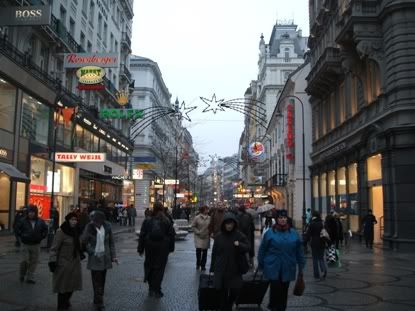
One of the main pedestrian shopping streets

There were some wonderful wide pedestrian streets, which contained all the usual suspects in terms of shopping possibilities. It definitely felt like being back in the west of Europe and one obvious clue was the sinful omnipresence of Starbucks coffeehouses; they're incredibly popular nearly everywhere in London as well and, although I don't actually drink coffee, people tell me the brews aren't even particularly notable.

Security was very high in general, since Austria has just taken Presidency of the European Union for the next six months, replacing the UK in this position. The friend I met here, another from the Youth Summit in Vilnius, was a good source of information - he does some work for the government so knew quite a lot about the new arrangements, including the likelihood of sniper squads patrolling prominent rooftops.

We met at the Café Schwarzenburg. I can't decide if that place was luxuriously sophisticated or pretentiously overelaborate. Uniform for the male waiters was bow tie and waistcoat, for example, but on the other hand, paintings on the walls were on sale. Quite a strange contrast. But Austrians are famed for their love of the café culture, so I suppose it makes sense for such places to exist in Vienna. They're probably all full of the same kind of people: retirees, businessmen, students and unknowns - generally a bit of everything. A selection of newspapers was available, including a few in English, but I was grumpily refused the Financial Times by an old guy in tweeds whose daily routine I'd clearly interrupted. I heard him being addressed as "Herr Doctor" by the staff, so I suspect he was a well-known customer.

This brings me to one of the weirdest pieces of Austrian history, maybe even on a global level in terms of bizarreness. I read in a travel book some months ago about the famous Sachertorte, a gourmet cake with a past riddled in conflict. This dry chocolate confection, with flavourings of apricot and usually served with cream, was first created by trainee chef Franz Sacher in 1832. Prince Metternich had demanded his private kitchen to produce a new dessert for an important dinner party and chaos ensued because the head chef was ill in bed. Responsibility ended up with 16-year-old apprentice Sacher and he produced the masterpiece from restricted resources.

After that he went on to open a Hotel in his name, which became famous for this cake and many other delicacies. The dispute arose when, for unknown reasons, his son decided to sell the recipe to the Demel pastry shop, another leading Viennese culinary institution. The Hotel Sacher and Demel soon entered a bitter struggle over who had the right to name their cake “Sachertorte”. Following an astonishing nine-year legal battle, in 1962 it was ruled the Hotel Sacher would name its version the “original Sachertorte”, with Demel taking “original Demel Sachertorte”.

Seems like a good compromise to me. But just think about it: a national dispute over the name of a confectionary product lasting all this time. It was only the court case that went on for nine years, people were arguing about it since long before then and probably still do. They definitely seem to like talking about it very much; after I asked the Scharzenburg waiter about the Sachertorte history and received an unexpected answer about ingredients, a local approached and excitedly enquired “Do you speak English?” before narrating the tale to me with all its fine intricacies.

So I suppose that was the highlight of my day (by the way, the cake was really good, if not a little overpriced). Despite the cold I still enjoyed walking the streets of Vienna, taking in the architecture and atmosphere of the city. An interesting feature of its traffic system are the “rings”, circular roads which span out from the centre – there are some nice tram rides along these routes. Vienna is another place I’d definitely like to explore again with more time; it’s really not worthy of only a day’s close attention.

Labels: ,